

How a simple practice became a significant piece of culture and heritage throughout history.
Introduction
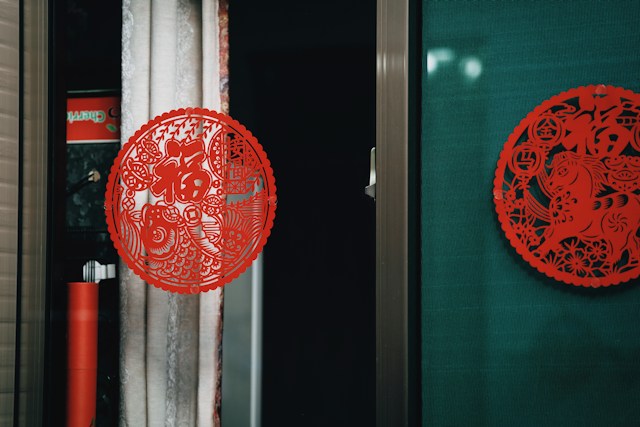
Chinese paper cutting is often introduced in a vivid image: a red silhouette of animals, symbols, or characters held delicately against the light. Yet each finished cutout has the essence of Chinese life, a deeper meaning that is overlooked without cultural context. Paper cutting is a way to encounter traditional craft, join a cultural community, and tell visual stories that carry all the way to the present. No single experience can represent all of the cultural and historical meaning behind it.
01 ·
Craft Across Changing Histories
Paper cutting emerged soon after Cai Lun’s invention of paper in the Han dynasty. His innovation revolutionized how knowledge was kept and shared, making paper culturally significant before anyone was cutting it into butterflies or lanterns. By the Tang dynasty, paper cuts were becoming part of formal spiritual ceremonies as offerings in Buddhist and Taoist traditions. They would represent purity, safety, or prayers.
When the Song dynasty began, paper cutting became a part of daily life. Families created chuang hua, or window flowers, with meanings that ranged from hoping for a flourishing household to wishing a family luck in difficult times. A pair of mandarin ducks came to symbolize love and fidelity, while plum blossoms represented resilience. Later in the Ming dynasty, fish and coins came to represent abundance, while peonies symbolized rising status and honor. They became part of wedding decorations and it was also the time when paper cutting became a communal activity. Family and friends came together to create designs representing their hopes and dreams.
By the Qing dynasty, paper cutting became diverse in cultures all around China. In the north, designs were expressive and depicted legends and mythical creatures. In the south, it became known for multi-layered compositions. This era also introduced more advanced tools and techniques. While scissors were still the most common tool in the north, the south developed custom knives that allowed them to cut multiple layers at the same time, allowing them to have hundreds of flawless details.
Though Western influences came to influence China, paper cutting grew to be part of preserving cultural identity.

02 ·
Cutting Memory into the Present
Paper cutting during the early days of the Communist Party became part of a new role: propaganda. It was repurposed to spread ideals across the entire population. Artisans created designs that represented workers, soldiers, and peasants. Paper cutting became a bridge between tradition and modern political movements.
However, during the rapid industrialization of the mid 20th century, paper cutting became a shadow of the past. Factories began mass producing decorations and the accessibility of printed materials was way more efficient than manual cutting. It was marked as counter-revolutionary during the Cultural Revolution and was only preserved in more rural parts of China.
Fortunately, in the early 21st century, China was a global power and wanted to preserve its culture and heritage. It was added to UNESCO’s Representative List of the Intangible Cultural Heritage of Humanity in 2009, igniting efforts to keep it alive.
Today, paper cutting is widely performed across the world, especially spreading through the internet. Whether one wants to learn about their culture, blend designs with modern technology, or create unique stories, paper cutting can fit it all. Paper cutting is not only a practice, but a unique experience of heritage that everyone can have.
Research Notes
Works Cited
- Lucchinelli, V. (2025, January 8). The history of Chinese paper cutting. Art Sprouts. https://artsproutsart.com/chinese-paper-cutting-history-symbols/
- The Chinese art of paper-cutting. (2024). Shanghai.Gov.Cn. https://english.shanghai.gov.cn/en-LearnChinese/20241119/131c9287ec36485286c86d4b903ab62e.html
- UNESCO. (n.d.). UNESCO - Chinese paper-cut. Ich.Unesco.Org. Retrieved September 9, 2026, from https://ich.unesco.org/en/RL/chinese-paper-cut-00219